← Home · Laboratory

Triaxial Testing in San Jose for Foundation Design and Slope Analysis

Together, we solve the challenges of tomorrow.

LEARN MORE →

The alluvial plains and bay mud deposits underlying much of San Jose present a distinct geotechnical challenge, particularly where the water table sits within five feet of the surface across the Santa Clara Valley. Foundation design here routinely demands more than index properties; it requires the effective stress parameters that only a triaxial test can reliably produce. Our team runs consolidated-undrained and consolidated-drained triaxial test programs on Shelby tube samples retrieved from the stiff clays of the Evergreen foothills and the interbedded silts near Coyote Creek. We calibrate each testing phase to the overburden pressure expected at the footing elevation, ensuring that the resulting cohesion and friction angle inputs reflect in-situ conditions rather than generic textbook values. For projects involving deep excavations along the Guadalupe River corridor, the pore pressure response measured during shear becomes a critical input for evaluating basal stability.
Where granular lenses complicate sampling, we pair the triaxial test with an in-situ CPT test to correlate tip resistance with drained strength, a method that helps bridge data gaps across the San Jose formation without relying on empirical tables alone.

A triaxial test doesn't measure shear strength; it measures the soil's stress history and its willingness to fail under the exact boundary conditions your foundation will impose.

Approach and scope

San Jose sits at roughly 82 feet above mean sea level, but the subsurface profile can swing from dense Pleistocene gravels to compressible Holocene clay within a single city block—a variability that makes standardized shear strength correlations unreliable. The triaxial test addresses this by isolating a cylindrical specimen under a confining pressure that replicates the field stress state, then shearing it at a controlled strain rate slow enough to permit pore pressure equalization. We typically run three specimens per unit at confining stresses bracketing the design load range, constructing a Mohr-Coulomb failure envelope that yields both the effective cohesion intercept and the drained friction angle. For the fine-grained soils common west of Highway 87, the test also captures the contractive versus dilative volumetric tendency, a behavior that governs whether a saturated layer will generate excess pore pressure during seismic shaking.
When the project schedule permits, we extend the program to include small-strain stiffness measurements using local axial transducers, producing a modulus degradation curve that feeds directly into liquefaction triggering analyses and deformation predictions for nearby infrastructure.
Triaxial Testing in San Jose for Foundation Design and Slope Analysis
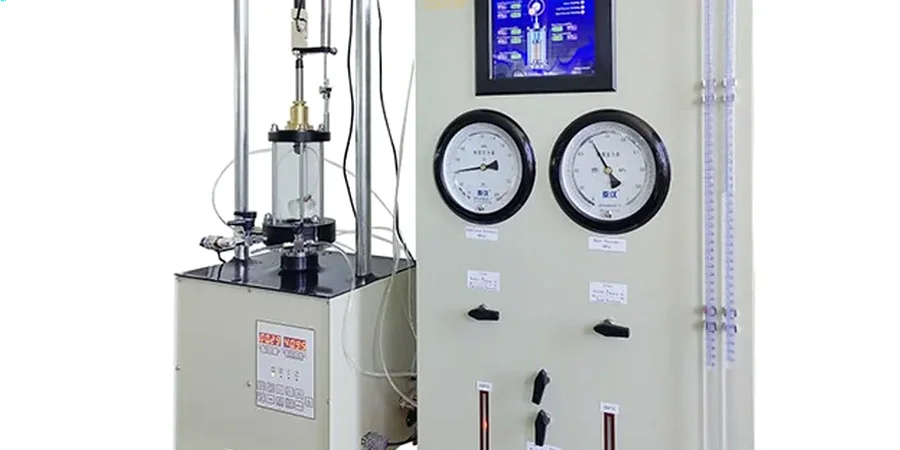
Technical reference image — San Jose

Site-specific factors

The most frequent mistake we see in San Jose geotechnical reports is the substitution of unconsolidated-undrained triaxial test values for effective-stress parameters in drained loading scenarios—a shortcut that can underestimate settlement by 40% in normally consolidated clays. Contractors who rely solely on pocket penetrometer readings or SPT blow counts for basement wall design in the Berryessa district are essentially designing blind to the pore pressure regime. Another costly error involves testing specimens at confining pressures too low to capture the overconsolidation signature of the upper crust; the resulting friction angle appears artificially high, and the excavation support system ends up under-designed.
We also encounter projects where the triaxial test program was specified correctly but the sample handling during transport introduced drying cracks or disturbance, rendering the measured cohesion meaningless. The ASTM D4767 requirement for a minimum B-value of 0.95 is not a bureaucratic checkbox—it is the difference between a drained strength envelope that reflects field conditions and one that reflects air in the pore system. Cutting this corner in the compressible deposits north of downtown San Jose has led to retaining wall deflections that damaged adjacent utilities and delayed project closeout by months.

Need a geotechnical assessment?

Reply within 24h.

Email: info@geotechnicalengineering1.com

Technical parameters

ParameterTypical value
Specimen diameter1.4 in or 2.8 in (undisturbed)
Testing standardASTM D4767 (CU) / ASTM D7181 (CD)
Confining stress range5 psi to 150 psi, project-specified
Back-pressure saturationSkempton B-value ≥ 0.95
Shear strain rate0.5% to 2% per hour, material-dependent
Pore pressure measurementMid-height transducer, continuous log
Output parametersc', φ', Af, E50, ν'
Report formatDeviator stress vs. strain, p'-q plots, Mohr circles

Complementary services

01

Consolidation and Stress History Profiling

One-dimensional consolidation testing on the same Shelby tube samples provides the preconsolidation pressure and compression indices needed to normalize the triaxial test data and estimate the overconsolidation ratio across the site. This pairing is standard practice for the compressible clays underlying the San Jose International Airport area.

02

In-Situ Vane Shear Correlation

For extremely soft deposits where tube sampling is impractical, we deploy field vane shear testing and correlate the undrained peak and remolded strengths with triaxial test results from adjacent higher-quality samples, building a calibrated profile that satisfies both the design engineer and the peer reviewer.

Relevant standards

ASTM D4767-11 (Consolidated-Undrained Triaxial Compression Test), ASTM D7181-20 (Consolidated-Drained Triaxial Compression Test), ASTM D4220/D4220M-14 (Preserving and Transporting Soil Samples), ASCE 7-22 (Minimum Design Loads for Buildings), IBC 2021 (International Building Code, Chapter 18)

Common questions

What is the typical turnaround time for a triaxial test program in San Jose?

A standard three-specimen consolidated-undrained triaxial test program, including saturation, consolidation, and shear phases, typically requires two to three weeks from sample delivery to draft report. Consolidated-drained tests on low-permeability clays can extend to four weeks due to the slow strain rate required for pore pressure dissipation. We carry out an interim data sheet with partial results at the one-week mark so that the design team can begin preliminary modeling while the full report is finalized.

How does the triaxial test differ from direct shear for retaining wall design?

The direct shear box forces failure along a predetermined horizontal plane and does not allow pore pressure measurement, which means it yields total-stress parameters that are difficult to apply in drained analysis. The triaxial test allows the specimen to fail along its natural plane of weakness and provides continuous pore pressure data. For a cantilever retaining wall in San Jose, where groundwater levels fluctuate seasonally, the effective friction angle from a triaxial test gives a more defensible active earth pressure coefficient than direct shear results.

Can you test gravelly soils from the deeper San Jose formation?

Gravels and cobbles exceeding roughly 0.75 inches in diameter cannot be tested reliably in a standard triaxial cell because the particle size violates the specimen diameter-to-particle ratio requirements of ASTM D4767. For these materials, we either reconstitute the sample by scalping the oversize fraction and correcting the strength envelope, or we shift the program to large-scale direct shear or in-situ testing methods. We assess the grain size distribution from the boring logs before committing to a testing protocol.

What does a triaxial testing program cost for a typical San Jose commercial project?

For a three-specimen consolidated-undrained triaxial test with pore pressure measurement on undisturbed Shelby tube samples, the laboratory fee generally ranges from US$2,140 to US$3,100, depending on the confining stress levels and whether small-strain stiffness measurements are included. This range reflects the technician time for saturation, the controlled strain rate shear phase, and the engineering interpretation report, and it assumes the samples are already extruded and trimmed at our San Jose laboratory.
Location and service area

We serve projects in San Jose and surrounding areas.

View larger map