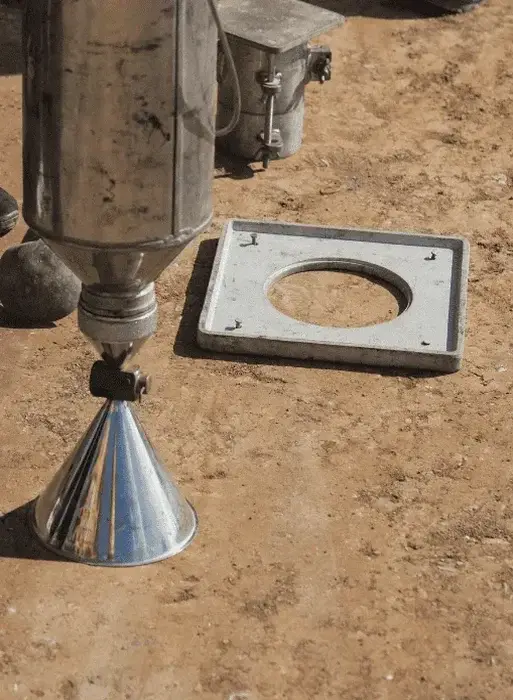
San Jose sits in a unique geological position at the southern end of the San Francisco Bay, where alluvial deposits from the Santa Clara Valley meet ancient marine sediments uplifted by the Silver Creek Fault. This juxtaposition means that fill compaction on one side of town can behave entirely differently than on the other, and a standard proctor curve alone won't catch the variance. The sand cone density test remains one of the most reliable field methods for verifying that compacted lifts actually meet specification, particularly in the silty clays and sandy loams that dominate Coyote Creek and Guadalupe River floodplains. When a plate load test is planned for foundation bearing verification, the sand cone data provides the in-place density baseline that makes those results interpretable. For roadway subgrades along expanding corridors like North San Jose, we often pair field density measurements with CBR testing to ensure the structural section won't fail prematurely under Silicon Valley's heavy commuter traffic.
A properly executed sand cone test in San Jose's heterogeneous fills can reveal compaction defects that nuclear gauges miss entirely in high-iron soils.
Approach and scope
San Jose's population has surged past the one-million mark, driving rapid infill development across the city's 180 square miles, and with that growth comes a steady demand for earthwork QA/QC that can keep pace with construction schedules. The ASTM D1556 sand cone method delivers a direct measurement of in-place density using calibrated Ottawa sand, a base plate, and a carefully excavated test hole that typically extends six to eight inches into the compacted lift. Unlike nuclear gauge readings, which can drift in the iron-rich residual soils found near the Almaden Valley's former mining districts, the sand cone test is immune to chemical interference and requires no radioactive source licensing. The procedure involves excavating approximately 1,500 grams of material, oven-drying it to determine moisture content per ASTM D2216, and calculating both wet and dry density against the laboratory maximum from ASTM D698 or D1557. One critical variable that contractors in San Jose often overlook is the moisture conditioning of the Ottawa sand itself, because the local ambient humidity in winter months can shift the bulk density of the cone sand enough to skew results by two or three percent if not recalibrated weekly.
Site-specific factors
The difference in compaction behavior between the deep clay deposits underlying downtown San Jose and the gravelly alluvium found along the eastern foothills near Evergreen is stark. In the downtown basin, where Quaternary bay mud extends to considerable depth, poorly compacted structural fill can settle differentially over just two wet winters, cracking slab-on-grade foundations that looked perfectly level at the time of pour. The eastern benchlands present a different challenge: granular fills with cobble content above three inches diameter cause bridging in the cone sand, leading to artificially low density readings if the technician excavates too aggressively instead of carefully hand-trimming around oversize particles. The most costly failures we see in San Jose involve utility trench backfill under arterial roads like Capitol Expressway, where inadequate density verification allows settlement troughs to form within the first year of traffic loading, requiring expensive pavement patching that could have been avoided with proper field density testing at the compacted trench subgrade.
Common questions
How much does a sand cone field density test cost in San Jose?
For projects in the San Jose area, a single sand cone density test with full documentation typically ranges from US$100 to US$140 per test point, depending on mobilization distance and the number of tests performed during a single site visit. Volume discounts commonly apply when scheduling 10 or more tests on the same day.
How does the sand cone method compare to a nuclear density gauge?
The sand cone test measures density directly by volume displacement, while a nuclear gauge infers density from gamma radiation backscatter or transmission. In San Jose's iron-rich residual soils and areas with high organic content near former marshlands, nuclear gauge readings can be unreliable, whereas the sand cone method is unaffected by soil chemistry. The trade-off is that sand cone testing is slower, typically requiring 20 to 30 minutes per test versus a few minutes for a nuclear gauge.
What soil types are suitable for the sand cone density test?
ASTM D1556 is suitable for soils with maximum particle sizes up to approximately 1.5 inches. In San Jose, this covers the vast majority of engineered fills, including the sandy clays and clayey sands common in Santa Clara Valley alluvium. For fills containing significant cobble content, such as those sourced from quarries in the eastern foothills, a larger test excavation or an alternative method like the water replacement technique may be more appropriate.
How many density tests are required for my San Jose project?
The International Building Code, adopted by the City of San Jose, requires a minimum of one field density test per lift per 1,500 to 3,000 square feet for structural fill, though the exact frequency is set by the geotechnical engineer of record in the project specifications. Utility trench backfill typically requires tests every 50 to 100 linear feet per lift, and roadway subgrade testing under San Jose Department of Public Works jurisdiction may have additional requirements.