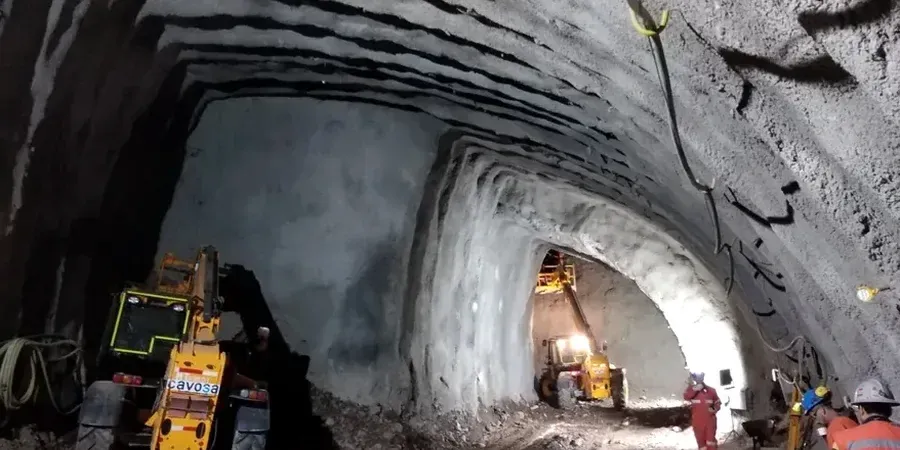
Boring logs from downtown San Jose nearly always tell the same story: fifteen to forty feet of compressible clay before you hit anything competent. Driving a tunnel through that profile changes the game entirely. You are not just excavating material; you are managing a water-charged, low-strength matrix that deforms the moment you relieve stress. Our geotechnical analysis for soft soil tunnels delivers the subsurface model that contractors and structural engineers need before selecting a TBM type or designing an initial support system. The work goes far beyond a standard soil report. We map the undrained shear strength profile, quantify consolidation settlement under various dewatering scenarios, and identify the transition zones where alluvial deposits interfinger with the deeper Franciscan Complex bedrock that defines the Coast Range foothills east of Highway 101. For projects near the Coyote Creek floodplain, where organic silts and peats complicate the upper horizon, we often pair the analysis with targeted CPT testing to get a continuous read on tip resistance and pore pressure without the disturbance that conventional sampling introduces.
Tunneling in San Jose soft ground is not about strength—it is about controlling deformation before it reaches the surface and impacts existing infrastructure.
Approach and scope
A recent mixed-use development proposed a utility corridor beneath Santa Clara Street, right where the historic groundwater table sits barely eight feet below the asphalt. The initial desk study suggested an open-cut approach, but the contractor wanted to evaluate a sequential excavation method to avoid disrupting light rail service. That analysis starts with a laboratory program that goes well beyond classification. We run consolidated-undrained triaxial tests to capture the effective stress parameters of the Young Bay Mud, then feed those numbers into a PLAXIS 3D model that simulates staged heading advance. Face stability calculations become critical when the overburden is less than one tunnel diameter. The team also runs Atterberg limits and grain size distributions on every split-spoon sample, because even a thin sand lens within the clay can trigger a running ground condition if it is not mapped ahead of the cutterhead. The final deliverable is a ground behavior profile that classifies each station meter by expected stand-up time, squeezing potential, and groundwater inflow rate.
Site-specific factors
The risk profile downtown near the San Jose McEnery Convention Center looks nothing like the conditions up in the Berryessa foothills. Downtown, you are dealing with a thick sequence of Holocene alluvium where the real hazard is excessive surface settlement. A half-inch of trough settlement at the tunnel crown can translate into cracked facades and tripped settlement pins on adjacent buildings. In East San Jose, the soil transitions to stiffer Pleistocene deposits interbedded with gravel lenses, and the primary concern shifts to boulder obstruction and erratic groundwater flow paths. Contractors who treat the entire city as a uniform soft-ground problem end up with mismatched tunnel boring machines and costly standstills. Our analysis for soft soil tunnels segments the alignment by geomorphic unit, assigning realistic deformation parameters to each reach so the contractor can plan compensation grouting and face support pressure accordingly. We also screen for the presence of artesian conditions, which have been documented in the Santa Clara sub-basin and can turn a stable tunnel face into a blowout risk within minutes.
Common questions
What is the typical cost range for a soft ground tunnel geotechnical investigation in San Jose?
A comprehensive investigation for a typical utility or transit tunnel alignment in San Jose generally ranges from US$3,780 to US$15,450, depending on the number of boreholes, the depth of the tunnel, and the extent of laboratory testing required. Shallow pedestrian tunnels fall toward the lower end, while deeper transit tunnels requiring advanced triaxial testing and 3D numerical modeling will be at the upper end.
How do you determine if the soil is too soft for a tunnel in San Jose?
We evaluate the undrained shear strength and sensitivity of the soil through a combination of in-situ vane shear tests and laboratory triaxial compression tests. A soil is considered challenging when its sensitivity exceeds 4 and its undrained shear strength drops below 25 kPa. In these conditions, face stability and surface settlement become the controlling design factors, and we work with the contractor to select an appropriate earth pressure balance machine or ground improvement strategy.
How long does a tunnel geotechnical investigation take in Santa Clara County?
A full investigation, from initial field mobilization through the delivery of the Geotechnical Baseline Report, typically takes five to eight weeks. Fieldwork, including drilling and cone penetration testing, usually requires two to three weeks. The remaining time is dedicated to the laboratory testing program and the development of the numerical models that simulate the tunnel construction sequence and its impact on adjacent structures.
What laboratory tests are essential for soft ground tunnel design in the Bay Area?
The essential suite includes Atterberg limits and grain size distribution for classification, consolidated-undrained triaxial compression tests to measure effective stress shear strength parameters, and one-dimensional consolidation tests to determine compression and recompression indices. For projects near the Bay margins, we also run salinity and sulfate tests on the groundwater and soil to assess the potential for chemical attack on the tunnel lining and support systems.