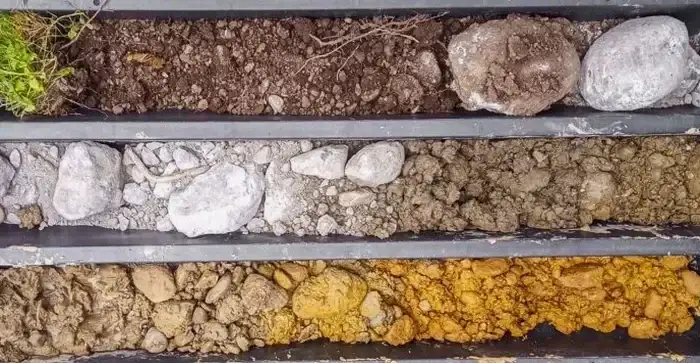
San Jose sits at roughly 82 feet above sea level, but what lies beneath varies wildly across its 180 square miles — from the deep alluvial clays of the Santa Clara Valley floor to the weathered bedrock pushing up against the eastern foothills. That subsurface unpredictability is exactly why a properly logged exploratory test pit can save a project from nasty surprises. The fault lines that crisscross the region, including the Silver Creek Thrust just southeast of downtown, remind every engineer in San Jose that soil behavior under seismic load is not theoretical. Our team uses exploratory test pits to expose the ground truth directly: we observe stratification, measure density, extract bulk samples, and document groundwater seepage at depths that boreholes sometimes miss. For sites near Coyote Creek or the Guadalupe River corridor, where soft organic silts and undocumented fill layers are common, the visual confirmation from an exploratory test pit often reveals conditions that SPT alone can't capture clearly. When the excavation reaches 14 feet in North San Jose and you see that lens of fat clay sitting right where the footing was drawn, you know the value of direct observation. We complement this approach with an in-situ density test when compaction verification is needed, and a plate load test when bearing capacity must be confirmed on site for a shallow foundation in San Jose's variable deposits.
Seeing the soil profile with your own eyes — the color change at the layer boundary, the water seeping through a sand lens — gives an engineer confidence that no remote sensing tool can match.
Approach and scope
The contrast between two San Jose neighborhoods tells you everything about the need for exploratory test pits. Over in Alviso, near the bay, you encounter high groundwater — sometimes within 3 feet of the surface — and soft, compressible Bay Mud that extends tens of feet deep. An exploratory test pit here gives you a direct look at the mottled gray clay and lets you sample the material for Atterberg limits testing right from the exposed face. Head south to Silver Creek, perched on Pleistocene alluvial terraces, and the same exploratory test pit might hit stiff sandy clay with gravel lenses at 4 feet, then weathered sandstone by 9 feet. Two sites, same city, entirely different foundation implications. The exploratory test pit methodology follows ASTM D2487 for visual-manual classification on the exposed walls, and where sampling is required we collect bulk bags or drive thin-walled tubes depending on the material consistency. For deeper investigation beyond the reach of a standard exploratory test pit, we often recommend pairing it with SPT drilling to extend the profile down to competent bearing strata. The pit wall becomes a window into the depositional history of San Jose's valley — and that window is irreplaceable for the geotechnical engineer deciding between a shallow spread footing and a deeper pile system.
Site-specific factors
The alluvial geology of San Jose, particularly the Quaternary deposits that blanket the valley, presents a real hazard: undocumented fill. Decades of agricultural leveling, orchard removal, and urban development have left pockets of debris, organic material, and loose soil that standard boring logs can miss. An exploratory test pit opens a wide enough window to spot these anomalies — a brick fragment at 5 feet, a layer of wood chips, or a sudden change from stiff clay to loose sand — that would slip between split-spoon intervals during an SPT program. In seismic design categories D and E, which apply across much of San Jose per ASCE 7, ignoring a soft fill layer can mean underestimating settlement and liquefaction potential. The exploratory test pit also allows direct measurement of the seasonal high groundwater table, critical in San Jose where perched water in the shallow alluvium fluctuates significantly between the dry summer months and the winter rains. If you skip this step, the consequence might not surface until the foundation is already in — and by then, remediation costs multiply fast.
Common questions
How deep can an exploratory test pit go in San Jose's soil conditions?
With a standard backhoe, we typically reach 12 to 14 feet in the stiff clays and sandy alluvium common across San Jose. If the material is loose or the water table is high, we bench the excavation or install shoring per OSHA 1926 Subpart P. For depths beyond 14 feet, an exploratory test pit becomes less practical, and we usually transition to an SPT drilling program to extend the profile to competent bearing strata.
What is the typical cost range for an exploratory test pit in San Jose?
For a standard exploratory test pit in San Jose, the cost generally falls between US$450 and US$760, depending on depth, access constraints, and whether shoring or traffic control is required. This includes excavation, logging by a field engineer, sample collection, and backfill with basic compaction.
How long does it take to get results from an exploratory test pit investigation?
The field work — excavation, logging, sampling, and backfill — is usually completed in a single day for one to two pits. If we send samples to the lab for grain size or Atterberg limits testing, you can expect the full report with stratigraphic profiles and laboratory data within five to seven business days. Rush turnaround is available when you have a tight construction schedule.
Do I need a permit to excavate an exploratory test pit in San Jose?
It depends on the location and depth. On private property for geotechnical investigation purposes, a standard exploratory test pit often falls under the project's overall site investigation scope and may not require a separate excavation permit. However, if the pit is in the public right-of-way or exceeds 5 feet in depth and requires worker entry, OSHA and local public works requirements apply. We handle the coordination with Underground Service Alert (USA North 811) for utility clearance on every job.