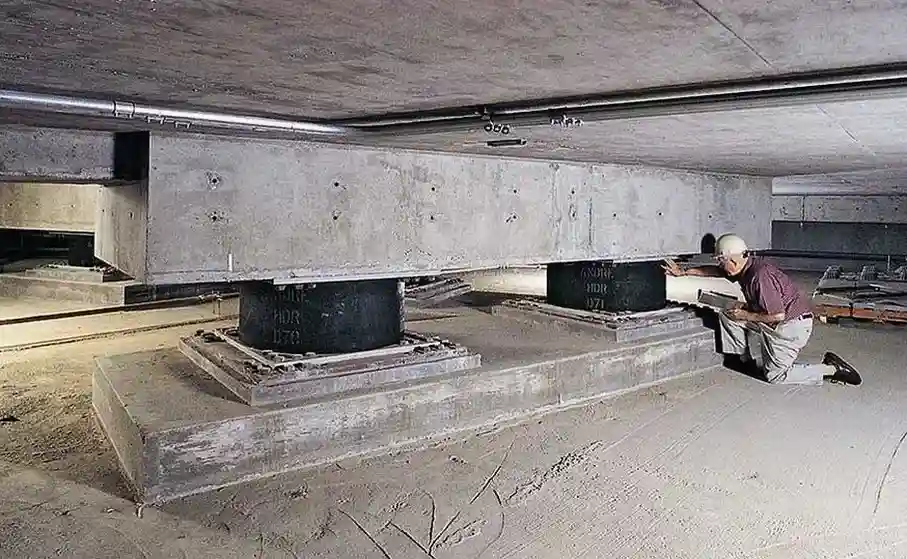
Too many project teams in Silicon Valley still assume a standard fixed-base design will handle San Jose's seismic reality. That assumption fails fast when you overlay the site on the USGS Quaternary fault map. The Calaveras Fault runs just east of the city, and the Hayward Fault sits less than 15 miles west. A fixed-base hospital or data center on the deep alluvium of the Santa Clara Valley amplifies ground motion in ways that rack interior equipment and fracture structural connections. We see the aftermath in post-earthquake reconnaissance reports. Our approach uses seismic microzonation data to tune the isolation system to the specific basin effects under your site. We also integrate findings from CPT testing to characterize the soft bay mud layers that influence the isolation period. The goal is a structure that stays operational, not just standing.
A well-tuned isolation system in the Santa Clara Valley can reduce spectral accelerations by 60% compared to a fixed-base condition on soft soil.
Approach and scope
The soil profile in North San Jose near the baylands differs drastically from the decomposed sandstone in the Almaden Valley foothills. In North San Jose, the younger bay mud deposits amplify long-period energy—exactly the range that affects isolated structures if the moat wall detailing is not coordinated with the geotechnical baseline. In Almaden, the stiffer materials push the site class to C or B, but the proximity to the San Andreas system still demands a solid nonlinear time-history analysis. We define the isolator properties—effective stiffness, characteristic strength, and post-elastic behavior—through an iterative process that matches the ASCE 7-22 Chapter 17 upper- and lower-bound analyses. Before finalizing the design, we often recommend a MASW survey to measure the shear wave velocity profile to 100 feet, confirming the Vs30 value that governs the site coefficients. The single concave friction pendulum or lead-rubber bearings we specify are then validated against the maximum considered earthquake.
Common questions
What is the typical cost range for a base isolation design package in San Jose?
For a mid-rise building in the San Jose area, the structural and geotechnical engineering fees for a complete isolation design package typically range from $4,140 to $8,070, depending on the number of isolators, the complexity of the nonlinear analysis, and the peer review requirements.
Which ASCE 7 provisions govern base isolation design?
ASCE 7-22 Chapter 17 governs the analysis and design of seismically isolated structures. It requires both upper- and lower-bound isolator properties, nonlinear response history analysis for most projects, and specific criteria for the isolation system and structural elements below the isolation plane.
Can an existing building in downtown San Jose be retrofitted with base isolation?
Yes, but the process involves cutting the columns and installing temporary jacking systems to transfer the load onto the isolators. The foundation system must be evaluated for the new load path, and a perimeter moat wall is required to allow the design displacement. We have executed this sequence on concrete and steel buildings in the Bay Area.
How does the deep bay mud under San Jose affect the isolation period?
The deep bay mud in San Jose has a natural period that can couple with the isolation system's effective period if not properly detuned. We perform site-specific response analyses to verify that the soil's fundamental period stays below the isolation period by a safe margin, typically targeting an isolation period of 2.5 to 3.5 seconds to avoid resonance with the soft soil.