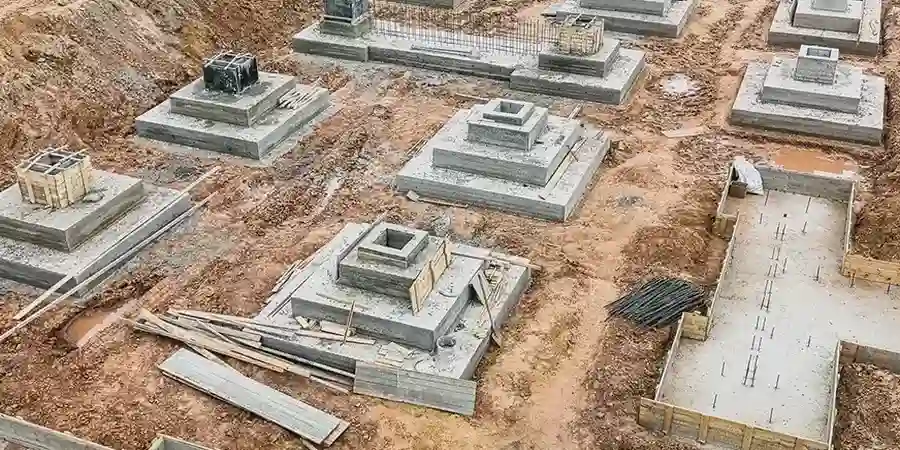
The alluvial plain that cradles San Jose conceals a subsurface that has tripped up more than a few foundation plans. Roughly 20 miles of loosely consolidated sediment separate the valley floor from bedrock, and the shallow water table—often just 8 to 12 feet down in the northern reaches of the city—introduces buoyancy and liquefaction concerns that a spread footing simply cannot address. When the Coyote Creek floodplain swells after a wet winter, pore pressures shift in ways that demand a deep foundation approach rooted in site-specific data. Our pile foundation design work in San Jose starts with that data, translating stratigraphy and seismic hazard into load paths that reach competent bearing strata well below the zone of seasonal influence. For projects near the Silver Creek fault traces, we often pair deep borings with a CPT test to map continuous strength profiles before selecting a pile type, ensuring the design reflects the actual stratigraphic layering rather than an idealized model.
Deep basin amplification in San Jose can double the spectral acceleration at periods critical for mid-rise pile-supported structures.
Site-specific factors
The most persistent misstep we see in San Jose is designing pile foundations on the assumption that refusal in a dense sand layer at 30 feet guarantees adequate bearing. In the Evergreen and Berryessa neighborhoods, that dense sand often overlies a softer clay stratum that consolidates over time, generating downdrag loads that were never accounted for in the structural design. Years later, the owner notices differential settlement between pile-supported and slab-on-grade elements, and tracing the cause back to an incomplete subsurface investigation is both expensive and litigious. Another pattern is ignoring the lateral demands imposed by liquefied soil flowing past piles during a major event on the Hayward Fault; the piles survive axially but crack under bending moments they were never detailed to resist. A thorough pile foundation design must include a kinematic bending check at the interface between liquefied and non-liquefied layers, something that is mandatory under current ASCE 7 provisions but still overlooked in fast-tracked projects.
Relevant standards
ASCE 7-22 Minimum Design Loads and Associated Criteria for Buildings and Other Structures, IBC 2024 (California amendments via CBC 2022), ASTM D1586 Standard Test Method for Standard Penetration Test (SPT) and Split-Barrel Sampling of Soils, ASTM D2487 Standard Practice for Classification of Soils for Engineering Purposes (Unified Soil Classification System), FHWA-NHI-16-010 Drilled Shafts: Construction Procedures and Design Methods, AASHTO LRFD Bridge Design Specifications, 9th Edition
Common questions
What subsurface conditions in San Jose typically require a pile foundation instead of a shallow footing?
Several conditions push a San Jose project toward deep foundations. The most common is the presence of liquefiable sands within the upper 40 feet—widespread in the Santa Clara Valley—which lose bearing capacity during seismic shaking. A high water table that limits excavation depth, thick layers of compressible Bay Mud near the Alviso area, or fill soils placed after the 1906 earthquake can also mandate piles. When the structural design requires settlement tolerances tighter than about 0.5 inches, shallow footings rarely meet that standard on the valley’s alluvial soils.
How does the deep basin effect in San Jose influence pile foundation design?
The Santa Clara Valley basin traps and amplifies seismic waves, particularly at periods between 1 and 3 seconds. For a mid-rise building on piles, this can mean spectral accelerations 40 to 60 percent higher than a generic rock-site spectrum would predict. Our design accounts for this by running a site-specific response analysis that models the full soil column down to bedrock—often 1,500 feet or more below downtown San Jose—and adjusting the input motion for the pile group accordingly.
What is the typical cost range for pile foundation design services in San Jose?
For a standard commercial or multi-family project in San Jose, pile foundation design operations—including the geotechnical investigation, site response analysis, pile capacity calculations, and preparation of construction specifications—typically range from US$1,930 to US$5,600, depending on the number of borings required and the complexity of the seismic modeling.
Which pile types perform best in the Santa Clara Valley’s soil profile?
Driven H-piles are common for steel-framed buildings because they penetrate dense alluvial layers efficiently and can be lengthened easily if refusal occurs deeper than expected. Auger-cast piles work well in the western part of San Jose where groundwater is high and vibration from driving would be problematic near sensitive equipment. In tight-access sites, such as downtown infill lots, micropiles drilled through fill and into the deeper competent stratum offer a practical solution with minimal disturbance.
What soil testing is essential before designing pile foundations in San Jose?
At minimum, we require SPT borings spaced to capture site variability, with undisturbed sampling for consolidation and triaxial testing on cohesive layers. Cone penetration testing (CPT) provides continuous stratigraphy and is especially useful for identifying thin liquefiable seams that SPT intervals might miss. Laboratory grain-size distribution and Atterberg limits are essential for classifying soils per ASTM D2487, and cyclic direct simple shear tests on saturated sands give the liquefaction triggering data needed for a defensible design.