The 2018 California Building Code (IBC Chapter 18) requires site-specific geotechnical analysis when weak, compressible soils are identified — a common condition across San Jose's Santa Clara Valley floor. Our laboratory supports stone column design by verifying input parameters through ASTM D1586 SPT correlation and ASTM D2487 classification, ensuring that load-transfer mechanisms match the actual subsurface profile. In San Jose, where alluvial deposits and Bay Mud lenses extend from Alviso down toward Coyote Creek, vibro-replacement columns must be dimensioned to control settlement below 1 inch for typical mid-rise structures. We validate friction angles in granular fill, undrained shear strength of the surrounding soft matrix, and stress concentration ratios that govern column spacing — all based on direct test data rather than generic assumptions. For sites near the Silver Creek fault traces, our liquefaction assessment provides the cyclic stress ratio thresholds that influence stone column densification requirements under M7.8 design earthquakes.
Stone column capacity in San Jose's Bay Mud relies on lateral restraint from the soft matrix — we measure that restraint directly through triaxial testing, not correlation tables.
Approach and scope
San Jose's post-war expansion pushed development deep into the Quaternary alluvial basin, where subsurface conditions transition abruptly from stiff Pleistocene gravels to normally consolidated silty clays within a few hundred feet. This stratigraphic complexity makes stone column design highly sensitive to the selection of cohesion and modulus parameters for the native soil matrix. Our laboratory extracts thin-walled Shelby tube samples from soft zones encountered during SPT borings, then runs consolidated-undrained triaxial tests to define the phi=0 strength envelope that governs the lateral confinement available to each aggregate column. We also conduct grain size analyses on the proposed granular backfill — typically a clean 1- to 3-inch crushed stone — to confirm compliance with ASTM D448 gradation numbers 57 or 6. Column diameter, typically 30 to 42 inches in San Jose projects, is matched to the pre-consolidation pressure profile so that bulging failure in the upper 4 to 6 column diameters is prevented under the design bearing pressure, which commonly ranges from 4,000 to 8,000 psf for shallow footings over improved ground.
Site-specific factors
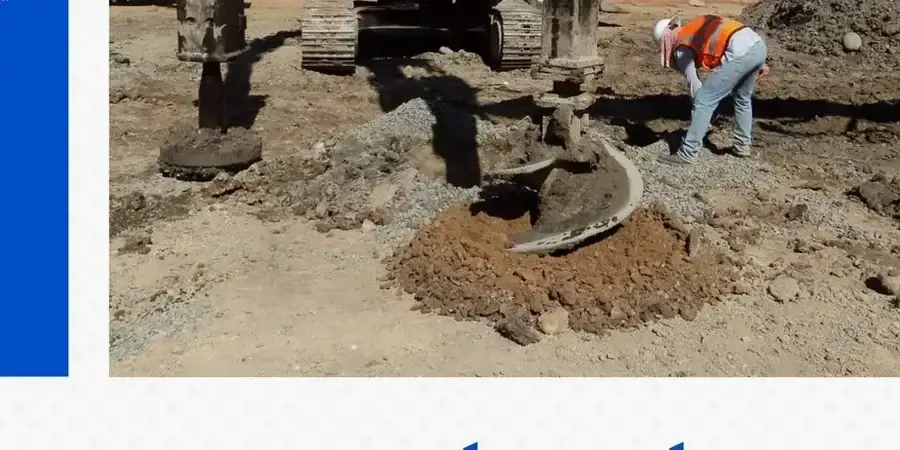
The vibroflot rig used on San Jose sites — typically a bottom-feed electric unit with a 130 to 200 hp motor — advances under water flush and compressed air to displace soft soil without extracting cuttings to the surface. The primary geotechnical risk we address in design is bulging failure in the upper portion of the column, where radial stress from the structure exceeds the passive resistance of the surrounding Bay Mud. If the undrained shear strength we measure in the lab drops below 300 psf, the column alone cannot develop sufficient lateral capacity, and we must specify a load transfer platform of densely compacted granular fill, typically 18 to 36 inches thick, reinforced with geogrid layers to distribute stress across multiple columns. In San Jose neighborhoods built on former marshland — such as parts of North San Jose near Highway 237 — organic silt layers with loss on ignition above 5% accelerate consolidation settlement even after improvement, requiring post-construction monitoring with settlement plates for a minimum of 12 months.
Relevant standards
IBC 2018 Chapter 18 — Soils and Foundations, ASCE 7-16 — Minimum Design Loads for Buildings, ASTM D1586 — Standard Test Method for SPT, ASTM D2487 — Classification of Soils for Engineering Purposes, ASTM D4767 — Consolidated-Undrained Triaxial Compression Test, ASTM D448 — Standard Classification for Sizes of Aggregate
Common questions
What is the typical cost range for a stone column design package for a San Jose project?
For a standard commercial or multi-family project in San Jose requiring 4 to 8 borings with laboratory triaxial and grain size testing, the complete design package — including parameter validation, column layout, and settlement analysis — typically falls between US$1,540 and US$5,470, depending on the number of soft layers tested and the complexity of the load transfer platform design.
How deep can stone columns be installed in San Jose's soil conditions?
Vibro-replacement columns in the Santa Clara Valley typically extend to depths between 20 and 60 feet, terminating in the stiffer Pleistocene alluvial gravels or dense sands that underlie the soft Bay Mud. The exact depth is determined by our SPT refusal criteria, targeting N-values above 30 blows per foot in the bearing stratum.
Can stone columns eliminate liquefaction risk in San Jose?
Stone columns reduce liquefaction susceptibility through densification and drainage, but they do not eliminate risk entirely in the high seismic hazard environment of San Jose. Our design incorporates a liquefaction-triggering analysis per ASCE 7-16 to verify that the improved ground meets the required factor of safety against cyclic softening under the design earthquake.
What laboratory tests are essential before designing a stone column layout?
At minimum, we require consolidated-undrained triaxial tests on undisturbed specimens of the soft cohesive layer to define undrained shear strength and modulus, grain size analysis per ASTM D422 on the native soil and the proposed backfill, and Atterberg limits to confirm plasticity characteristics. For sites with organic silt, loss-on-ignition testing is also performed to assess secondary compression potential.