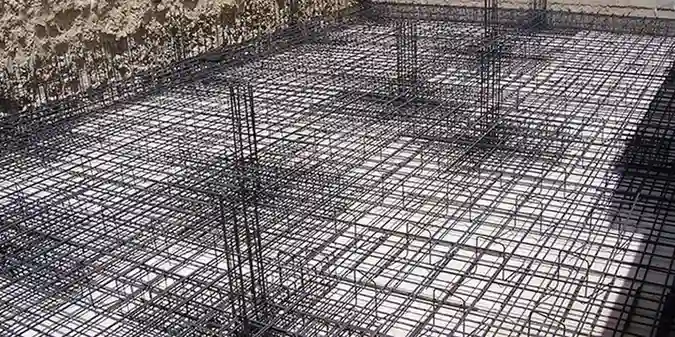
In San Jose, we often see sites where isolated footings just won't cut it—soft alluvium, high groundwater in the Santa Clara Valley, or liquefiable layers at shallow depth. The city sits roughly 37°N, 121°W, and much of its flatland geology consists of interbedded clays, silts, and sands deposited by Coyote Creek and the Guadalupe River. When bearing capacity drops below 1,500 psf or differential settlement exceeds tolerance, a raft/mat foundation becomes the logical path. Our team runs the subsurface investigation, extracts undisturbed samples, and runs triaxial tests to get the strength parameters needed for a reliable mat design. We coordinate directly with structural engineers to deliver a foundation scheme that fits San Jose’s soil profile and seismic environment without overdesigning the slab thickness.
A properly designed mat foundation in San Jose’s alluvial soils can reduce differential settlement by 60% compared to isolated footings on the same strata.
Approach and scope
A common mistake we see in the San Jose area is designing a mat foundation using textbook soil values without verifying site-specific stratigraphy. The upper 10 to 15 feet can shift dramatically across a single parcel—stiff clay on one corner, loose sand lens on another. That variability skews the modulus of subgrade reaction and can lead to under-reinforced sections. We address this by combining CPT soundings with laboratory consolidation and strength tests. Our lab runs ASTM D2487 classification and ASTM D1586 SPT correlations to define the bearing stratum. We model the mat as a flexible or rigid plate depending on the relative stiffness between the concrete and the subgrade, following IBC Chapter 18 and ASCE 7-22 provisions. The result is a foundation that spreads the load across the entire footprint, reduces differential settlement, and handles the moderate-to-high seismic demand typical of Santa Clara County. For sites near the Silver Creek fault trace, we also adjust the design for potential ground rupture scenarios.
Common questions
How much does raft/mat foundation design cost for a residential project in San Jose?
For a typical single-family home or small commercial building in the San Jose area, the geotechnical investigation and mat foundation design package runs between US$910 and US$3,680. The spread depends on the number of borings required, lab testing scope, and whether a finite element analysis is needed for irregular mat geometry.
When should I choose a raft/mat foundation instead of isolated footings in San Jose?
You should consider a mat foundation when the allowable bearing pressure drops below 1,500 psf, when predicted differential settlement between columns exceeds ½ inch, or when the water table is within 5 feet of the bottom of the footing. San Jose’s alluvial clays and silts often tick two or three of those boxes on the same site.
How do you handle buoyancy and uplift on a mat foundation in high groundwater areas of San Jose?
We calculate the net uplift force as the difference between the hydrostatic pressure at mat underside and the dead load of the structure. If buoyancy is a concern, we specify a thicker mat, add a drainage layer with perimeter collection pipes, or design tension piles to anchor the slab. The solution depends on the seasonal high groundwater level measured during the wettest months in Santa Clara Valley.